
Materiality (priority issues)
Based on our management philosophy and the concept of sustainability, we identify issues where our business activities are highly relevant to social issues from the perspective of ESG.
We then designate those issues as materiality (priority issues), and select important themes to associate with them.
We associate specific materiality (priority issues) with SDGs and contribute to achieving SDGs via initiatives for resolving the materiality (priority issues).
We have set five sustainability-related indicators and targets and are working to achieve each.
In the future, we will consider and set new indicators and targets to enhance our sustainability efforts.
1. CO₂ emissions are for Scope 1 and Scope 2.
2. The aggregation period for paid leave days taken is from June 16, 2025, to June 15, 2026.
3. Metrics and targets other than "CO₂ emissions reduction" are subject only to KING JIM.
Regarding our target to reduce CO₂ emissions (Scope 1 and Scope 2), we achieved the fiscal 2030 target in the fiscal year ended June 2026. We will continue working to control emissions and maintain the reductions achieved.
Step 1: Identifying Social Issues
When identifying materiality (priority issues), we selected the social issues to consider based on international sustainability frameworks such as the GRI standards, SDGs, ISO26000, SASB, and the evaluation items of ESG ratings agencies. Step 2: Evaluating the Importance of Social Issues
When evaluating the importance of the selected social issues, we identified the issues with the highest priority for the KING JIM Group based on A) level of demand/expectations from society and stakeholders and B) level of business impact.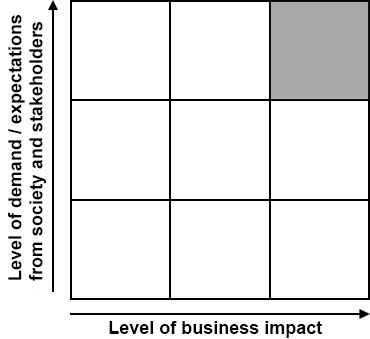 Step 3: Deciding Materiality (priority issues)
We identified the final materiality (priority issues) upon an investigation by external experts, and received approval by the board of directors. Step 4: Planning Action
We will periodically review the materiality (priority issues) in the future and aim to continuously improve corporate value via further integration with management strategy.
We then designate those issues as materiality (priority issues), and select important themes to associate with them.
We associate specific materiality (priority issues) with SDGs and contribute to achieving SDGs via initiatives for resolving the materiality (priority issues).
How Materiality (priority issues) Correspond with SDGs
| Materiality (priority issues) |
Important Themes | Relevant SDGs |
| ■ Social contribution via the development of original products | -Providing new value not found in the world -Developing sustainable products -Ensuring quality management -Obtaining and protecting intellectual property -Implementing and disseminating our management philosophy |
     |
| ■ Environmental consideration | -Reducing CO2 emissions -Promoting the 3Rs -Managing waste |
  |
| ■ Promotion of diverse human resources | -Ensuring labor health and safety -Promoting diversity -Cultivating human resources -Promoting work-life balance |
  |
| ■ Enhancement of governance | -Ensuring compliance -Performing risk management |
 |
Indicators and Targets
In the future, we will consider and set new indicators and targets to enhance our sustainability efforts.
| Metrics | Targets | FY 6/2026 Actual |
| Sales Ratio of Eco-Friendly Products | Achieve 80% in the FY 6/2030 | 74% |
| Reduction of CO₂ Emissions (Scope 1 + 2) | Reduction of 32% in the FY 6/2030 compared to FY 6/2021 | Decrease of 33.2% compared to FY 6/2021 |
| Recycling and Reuse Rate | Maintained 76% recycling and reuse rate of collected used "TEPRA" PRO Tape Cartridges. | 76% |
| Ratio of Female Managers | Achieve 30% in the FY 6/2030 | 18.6% |
| Number of Days of Paid Leave Taken | An average of 13.5 days was acquired in the FY 6/2030 | 13days |
2. The aggregation period for paid leave days taken is from June 16, 2025, to June 15, 2026.
3. Metrics and targets other than "CO₂ emissions reduction" are subject only to KING JIM.
Selection Process
When identifying materiality (priority issues), we selected the social issues to consider based on international sustainability frameworks such as the GRI standards, SDGs, ISO26000, SASB, and the evaluation items of ESG ratings agencies. Step 2: Evaluating the Importance of Social Issues
When evaluating the importance of the selected social issues, we identified the issues with the highest priority for the KING JIM Group based on A) level of demand/expectations from society and stakeholders and B) level of business impact.
We identified the final materiality (priority issues) upon an investigation by external experts, and received approval by the board of directors. Step 4: Planning Action
We will periodically review the materiality (priority issues) in the future and aim to continuously improve corporate value via further integration with management strategy.


 Environment
- Environmental Policy
- Responding to Climate Change
- Eco-Friendly Products
- Collecting "TEPRA" PRO Tape Cartridges
- Environmental Conservation Activities
 Social
- Labor Health and Safety
- Promotion of DE&I
- Human Resource Development
- Work-Life Balance
- Human Rights
- Procurementt
- Product Safety
- Social contribution
 Governance